
Sustainability · 13 min read
EU Packaging Rules for Events: What PPWR Changes on the Catering Table
The EU’s packaging regulation started applying on 12 August 2026. The obligation that is live now is far narrower than the coverage suggested, and the expensive one arrives on 1 January 2030. Here is what it changes on a catering order, including when your venue sits outside the EU.
What’s in this guide
What actually changed on 12 August 2026
The EU’s Packaging and Packaging Waste Regulation, PPWR, entered into force on 11 February 2025 and started applying on 12 August 2026. If you read the trade press in August you would be forgiven for thinking single-use plastic had just been banned from every conference floor in Europe. It had not.
The obligation that is live now is narrow and specific. Food-contact packaging containing per- and polyfluoroalkyl substances above strict limits can no longer be placed on the EU market. The European Commission names the formats it has in mind: takeaway containers, fast-food wrappers, microwave popcorn bags, bakery paper and pizza boxes. In catering terms, that is the grease-resistant paper and board category, the liners and wraps that stop oil soaking through.
Note who the obligation sits on. PPWR restricts placing packaging on the market. That duty falls on manufacturers, importers and distributors, not on the company organising a conference. Your caterer does not sign anything. What changes is the catalogue your caterer buys from, and that change has already happened upstream.
Worth knowing
Nothing about single-use plastic cups, stirrers or portion packs became unlawful on 12 August 2026. Those restrictions arrive on 1 January 2030. The gap between those two dates is the planning window, and most procurement teams have not noticed it exists.
The dates between now and 2030
PPWR is a staged regulation, which is why the coverage was so confused. Here is the sequence that matters to anyone buying catering, delegate materials or room drops.
| Date | What applies | Who feels it first |
|---|---|---|
| 11 February 2025 | Regulation enters into force | Legal and compliance teams |
| 12 August 2026 | Regulation starts applying. PFAS restriction on food-contact packaging | Caterers and their packaging suppliers |
| 12 February 2027 | Commission deadline to adopt rules setting a minimum number of rotations for reusable packaging | Reusable service suppliers |
| 12 February 2028 | Commission deadline for the empty space calculation methodology | Delegate kit fulfilment and logistics |
| 12 August 2028 | Harmonised packaging labelling replaces national schemes | Procurement, signage and waste sorting |
| 1 January 2030 | Single-use plastic restrictions, 50 percent empty space cap, reuse targets, recycled content minimums, all packaging recyclable | Everyone |
| 1 January 2035 | Packaging must be recyclable at scale | Everyone |
| 2038 | All packaging must reach recyclability grade A or B | Everyone |
Two of those dates are Commission homework rather than industry deadlines, and they are the ones worth watching. The reusable packaging rotation rules are due by 12 February 2027, which means suppliers will start quoting reuse systems with real numbers attached from next year. The empty space methodology is due by 12 February 2028, two years before the 50 percent cap bites.
Where this lands on a catering order
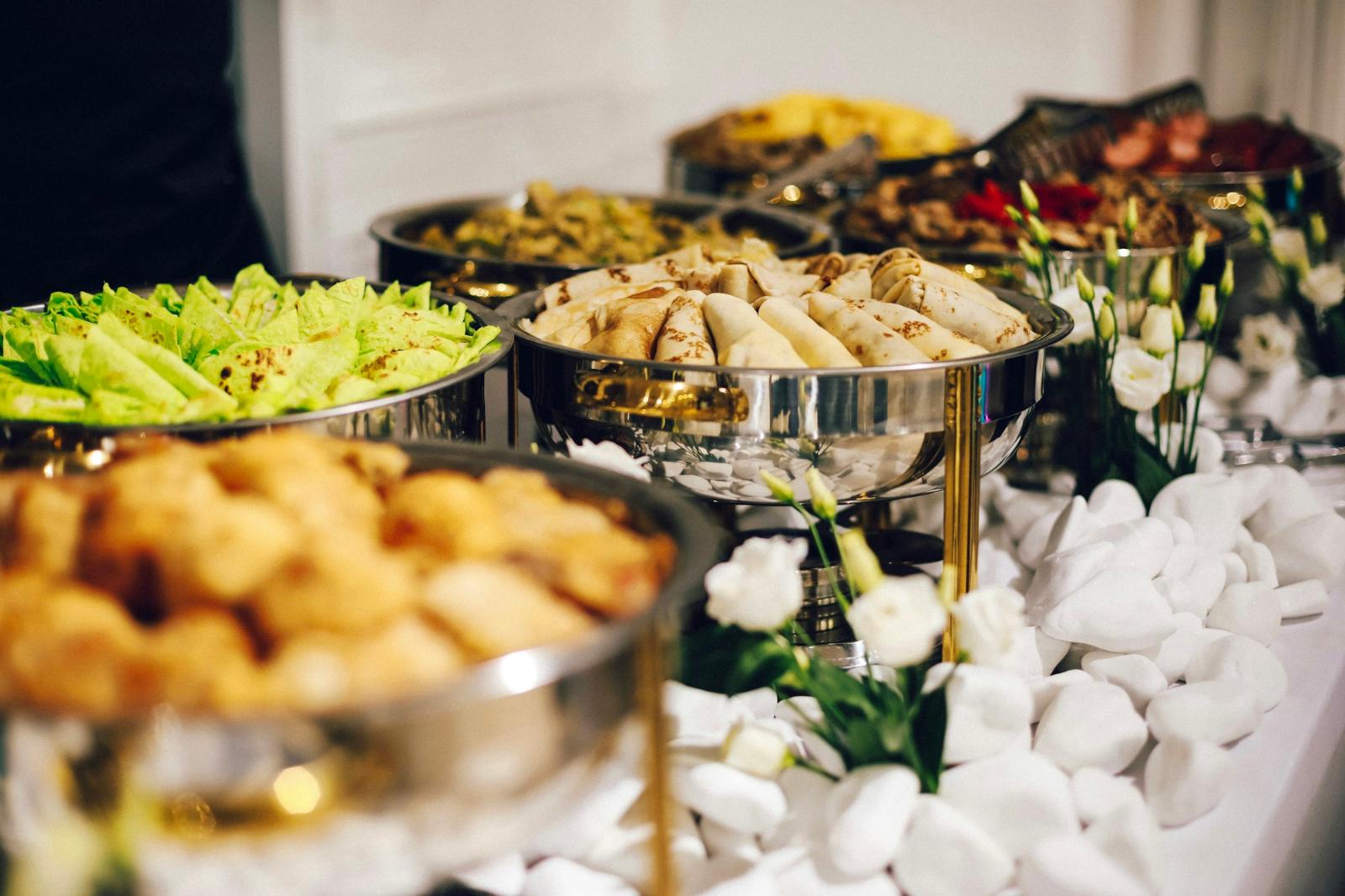
Walk a buffet line and count the packaging. Chafing dish liners, tray wraps, portion packs, individually sealed butter and preserve pots, cling film over anything waiting to go out. Almost none of it reaches the delegate, and almost all of it is in scope of something on the timeline above.
The PFAS restriction that is already live touches the grease-resistant layer first. If your caterer uses moulded fibre boxes, lined boards or treated paper for hot transfers, their supplier has either reformulated or withdrawn the line. The right question in a site visit is simple: what has your packaging supplier substituted, and when.
The 2030 restrictions reach further into a programme than most planners expect:
- Grouped packaging for cans and bottles: the shrink-wrapped tray of water or soft drinks delivered to a conference floor is a listed single-use plastic format. From 1 January 2030 it goes.
- Fresh fruit and vegetable packaging under 1.5 kg: this is the clause that touches fruit bowls, crudite platters and healthy break stations.
- Hotel miniatures: single-use toiletries under 50 ml or 100 g are restricted. On residential programmes that is every bathroom amenity and every welcome room drop built around a miniature.
- Plastic carrier bags under 15 microns: the thin bag inside a delegate bag.
For an Albanian programme the money sits elsewhere, which is worth saying plainly. A working lunch runs €18 to €25 per head, a restaurant dinner €28 to €45, a welcome reception €22 to €35, a gala dinner in a private venue €55 to €90, and €110 to €180 once you add full production. The packaging line inside those figures is a rounding error. What costs money is not the packaging; it is the supplier switch, the relabelling, and building an audit trail your client’s reporting team will accept.
The expensive part of a packaging rule is never the packaging. It is proving what you used.
Coffee breaks, delegate kit and the reuse question
Per delegate, nothing on a programme generates more packaging than a coffee break. Individually wrapped biscuits, UHT milk pots, sugar sticks, single-serve jams at breakfast, stirrers, cup lids, and on a bad day a bottled water for every chair. A 200 delegate conference with three breaks a day across two days can clear four thousand small items that exist for under a minute each.

Reuse targets are a 2030 obligation, and the delegated rules fixing the minimum number of rotations are due by 12 February 2027. That is close enough that the sensible move is to stop waiting. Carafes and glassware cost nothing extra in a hotel that already owns them. Bulk milk, bulk sugar, butter and preserves in dishes rather than pots, and no bottled water on tables will strip the largest packaging line out of a day meeting without a single line of regulation forcing it.

Delegate kit is the quieter problem. From 1 January 2030 transport and e-commerce packaging must keep its empty space ratio at or below 50 percent, with the Commission methodology due by 12 February 2028. If you ship branded materials across borders to a venue, that is the clause to raise with your fulfilment house, because a half-empty box is currently nobody’s problem and will shortly be somebody’s.
Outside the EU, inside the client’s policy
Albania is not an EU member state, so PPWR does not bind an Albanian caterer or an Albanian hotel. Planners sometimes hear that and relax. They should not.

First, the direction of travel is settled. Albania opened Cluster 4, “Green agenda and sustainable connectivity”, at the sixth meeting of its Accession Conference in Brussels on 16 September 2025. That cluster contains Chapter 27, Environment and climate change, alongside transport, energy and trans-European networks. In November 2025 the final remaining negotiating cluster opened. Alignment with the EU packaging framework is a question of sequencing, not of whether.
Second, and far more immediately, the client’s own procurement policy travels with the delegates. A company headquartered in Frankfurt or Milan that reports under the Corporate Sustainability Reporting Directive asks the same packaging questions in Tirana that it asks at home, because its own disclosure depends on the answer. We now see packaging and waste clauses in RFPs for Albanian programmes that would have been unthinkable three years ago, written by sustainability teams rather than by event teams.
Distance does not insulate anyone either. Tirana is 1 hour 50 minutes from Munich on a direct service, so a corporate sustainability lead is one short flight from your venue. Beyond the capital, Berat sits about two hours from Tirana by coach, Gjirokastër about three and a half, and Sarandë four and a half to five. The Palace of Congresses in Tirana seats 2,100, and the Tirana Marriott’s Amantia Ballroom takes up to 400 theatre style. A 50-seat coach airport transfer in greater Tirana runs €180 to €260 per movement. Albanian VAT is 20 percent as standard, with 6 percent on accommodation supplied by licensed hotels and on tourism packages sold by licensed tour operators.
The operational reality on a coastal programme is that regulation is not the binding constraint; delivery distance is. A caterer sending a plated dinner four and a half hours south to Sarandë depends on packaging to hold temperature and structure for the whole run. When we ask about PFAS-free substitutions on those long transfers, the first thing a caterer pushes back on is the grease-resistant liner, because that is the component doing the real work. That conversation is easier to have in February than in July.
What to put in your next catering brief
None of this requires a sustainability consultant. It requires seven lines in a brief, and the authority you already have as the person paying.
- Ask the caterer to confirm in writing that food-contact packaging used on site meets the PFAS limits applying in the EU from 12 August 2026, whether or not the venue sits inside the EU.
- Specify reusable water service as the default: carafes and glassware, no bottled water on tables, refill stations in the foyer.
- Specify bulk service for milk, sugar, butter and preserves instead of single-serve portions.
- Ask for the packaging and disposables line to be itemised in the quote rather than absorbed into the per-head rate. You cannot manage a cost you cannot see.
- On residential programmes, ask whether bathroom amenities are bulk dispensers or miniatures, and settle it now rather than in 2029.
- For shipped delegate kit, ask the fulfilment house what its current empty space ratio is and what it plans to do about the 50 percent cap.
- Keep the paperwork. Specification sheets, supplier declarations and waste records are what a reporting team needs. Intentions do not survive an audit.
The useful frame is this: PPWR obligates the people placing packaging on the EU market. It does not obligate you. Your power sits in the brief, and a brief costs nothing to write.
FAQs
Does PPWR apply to my event?
Not directly. PPWR regulates placing packaging on the EU market, so the duties fall on manufacturers, importers and distributors rather than on event organisers. It reaches your event indirectly, through what your caterer and suppliers are able to buy, and through your client’s own procurement and reporting requirements.
What exactly became unlawful on 12 August 2026?
Placing food-contact packaging on the EU market with per- and polyfluoroalkyl substances above strict limits. The European Commission points to takeaway containers, fast-food wrappers, microwave popcorn bags, bakery paper and pizza boxes as the typical formats affected.
Are single-use plastics banned at events now?
No. The restrictions on specified single-use plastic formats, including grouped packaging for cans and bottles, packaging for fresh fruit and vegetables under 1.5 kg, hotel miniatures under 50 ml or 100 g, and very thin plastic carrier bags, apply from 1 January 2030.
Does PPWR apply in Albania?
No. Albania is outside the EU single market, so the regulation does not bind Albanian caterers or hotels. Albania opened Cluster 4 of its accession negotiations, which contains Chapter 27 on environment and climate change, on 16 September 2025, so alignment is expected over time. In practice the pressure arrives sooner through EU client procurement policies than through Albanian law.
When do hotel miniatures disappear?
Single-use toiletries under 50 ml or 100 g are restricted from 1 January 2030. Hotels running large refurbishment cycles are already specifying bulk dispensers, so on many properties the change will land earlier than the deadline.
How does this connect to CSRD reporting?
Packaging and waste sit inside the environmental disclosures a reporting company has to make, so a client reporting under CSRD needs evidence from its event suppliers. That is why packaging questions now appear in RFPs for destinations where PPWR has no legal force.
Related guides
Planning a programme that has to survive a procurement review?
We itemise the catering, the disposables, the transport and the VAT treatment up front, so your sustainability team sees the whole picture before you commit.